Talking to a friend last week and he summarised my approach to life as “it doesn’t have any meaning, but that’s ok”. Which is spot on. I do actually envy people who can convince themselves there is ultimately a point – that there’s fate or a god, or something watching over them – to be able to turn off the rational part of their mind like that at will. That’s not supposed to sound snide or anything, it’s a skill, and there’s a demonstrable link between being able to do that and positive mental health.
That sort of thing is easier in crowds the “collusion in delusion” which explains the popularity of church, or sporting events, or cinemas, and of course most of us can do it for specific periods and locations, it’s the theoretical basis for much of playful learning – Huizinga’s magic circle. There’s contentment in those moments and searching for spaces that can help us reach that point can be worth seeking out. A prime example for me was Seonbawi rock in Seoul.
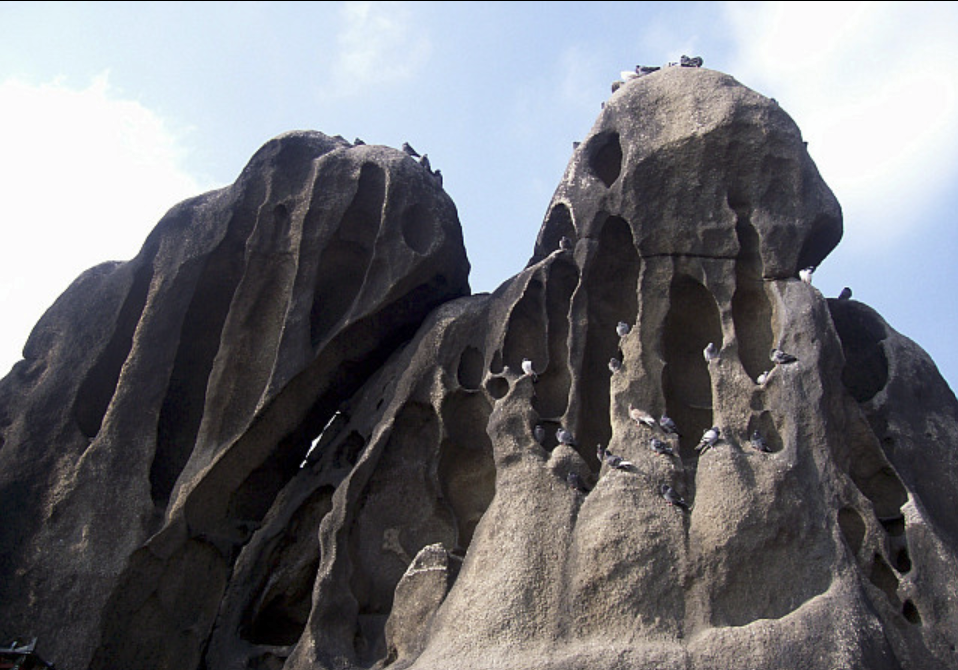
There was something about the peacefulness, the immense solidity of those two rocks, the tolling of a bell at sunset from a nearby temple, everything just felt … OK. Only one person visited during the hour or so I was there, and it’s a touchpoint I can call up. I’ve not found the equivalent in the NE of the UK, except I guess looking out down on the valley my home sits at the end of. Sheep, cows, rabbits, various birds, connects me (well anyone) to those metanarratives Serres discusses in The Natural Contract.
Of course, there’s not actually any pattern – thinking you can see one is a warning of incipient apophenia. Something to be indulged in briefly, but can tip from rabbit-hole to tar-pit if you’re not watchful. Don’t believe in yourself, don’t deceive with belief. All that quicksand stuff.
But when you’re enacting practice, teaching, researching, doing your job, is it necessary to think that ultimately there’s a point to motivate yourself to keep going? I was reading Lyotard last week, The Inhuman (specifically “Can Thought Go on without a Body?”) and in that he discusses the post-solar humanity (I’m studying post-humanism and trans-humanism) and he discusses the ultimate fate of humanity to be either destruction when the sun dies, or to escape this destruction by becoming something non-human. Lyotard’s point of this is to show the fundamental error in unlimited technological progress – either it’s not possible because the sun will undergo a helium flash in 4.5 billion years, or it’s undesirable because the only logical end point is for us to not be human any more.
To which I’d answer “generation starships”. Or “pantropy”. Or any of the known SF solutions. I don’t read that Lyotard’s question as a hypothetical – I mean what are we going to do? I’m reminded of a line from a Woody Allen routine where a woman turns him down with the line “not even it would help the space programme”. Is all our endeavour actually reducable to this one goal? It could work for me – understanding virtual embodiment, how humanity is reflected in our avatars, how an extended body works via telepresence, all that could help us survive the ultimate fate of the solar system. How would what you do help anything long term? Except …
we’re just postponing the inevitable. The heat death of the Universe. There is no long term solution.
Maybe just getting a few extra billion years on humanity’s clock is point enough? But it could possibly all seems a bit abstract for day-to-day life. I was chatting with another friend over the weekend and her answer was to have as much fun as possible without causing harm to anyone.
Not sure how that justifies me doing what I do. I suppose a lot of it is fun, and when it’s not fun I justify it in terms of it earning me enough of a living to spend money on things that are fun. I’m sure there’s an integral equation for that so that you could work out how to maximise fun over time. But that, as a philosophy has actually been captured succinctly by The Wyld Stallyns.
Be Excellent to Each Other
Party On Dudes
Is that actually ultimately the point?
 The Body Electric